
The federal government has earmarked an additional $4.9 billion for the Cheaper Home Batteries Program while revamping the scheme to ensure incentives taper off for oversized home batteries, which were rapidly depleting the budget.
How Is The Federal Battery Rebate Changing?
The original $2.3 billion budget has been massively expanded to $7.2 billion over the next four years. The federal government expects this funding will see more than two million Australians install a battery by 2030—double the number initially predicted. This uptake is anticipated to deliver 40 gigawatt-hours of additional storage capacity.
The funding boost will be accompanied by tightened requirements. The rebate will now decline at a higher rate every six months, rather than the annual reduction initially planned. Furthermore, the value of the rebate will be significantly reduced for larger home battery systems under a new tiered system.
These changes will apply to home batteries installed from the start of May 2026, with further reductions occurring each January and July through to the end of 2030.
Why Is The Scheme Being Revamped?
The federal battery rebate was on track to exhaust its originally allocated funding by mid-2026. While the $2.3 billion budget was intended to last across the four-year forward estimates period, analysis of the numbers suggested it was on track to run out in just one year. Warning signs regarding this rapid depletion have been evident since late July, less than a month after the scheme launched.
The Department of Climate Change, Energy, the Environment and Water claims the incentive has been reworked to align with declining battery costs, aiming to maintain roughly a 30% discount for battery systems. Federal government officials acknowledged they did not foresee the high volume of large batteries that would be installed under the scheme.
Energy Minister Chris Bowen stated: “We want more Aussie households to have access to batteries that are good for bills and good for the grid – because it means more cheap, fast, safe solar energy is available in our homes night or day, when and where it’s needed. By responsibly managing the budget, we’re able to fund the things that matter most to Australians such as strengthening Medicare, cheaper medicines, slashing student debt, expanding our Cheaper Home Batteries program and tax cuts for every taxpayer.”
Incentive To Drop Faster & More Frequently
The Cheaper Home Batteries Program discount is provided through government purchases of Small-scale Technology Certificates (STCs). Subject to regulations being made, the STC factor—which determines the number of STCs a system is entitled to create per kWh of usable capacity—will drop every six months instead of every year, and by a steeper amount.
According to the Department of Climate Change, Energy, the Environment and Water, the estimated value of the rebate per kWh under the revised scheme is as follows:
- Rest of 2025: $372 per kWh
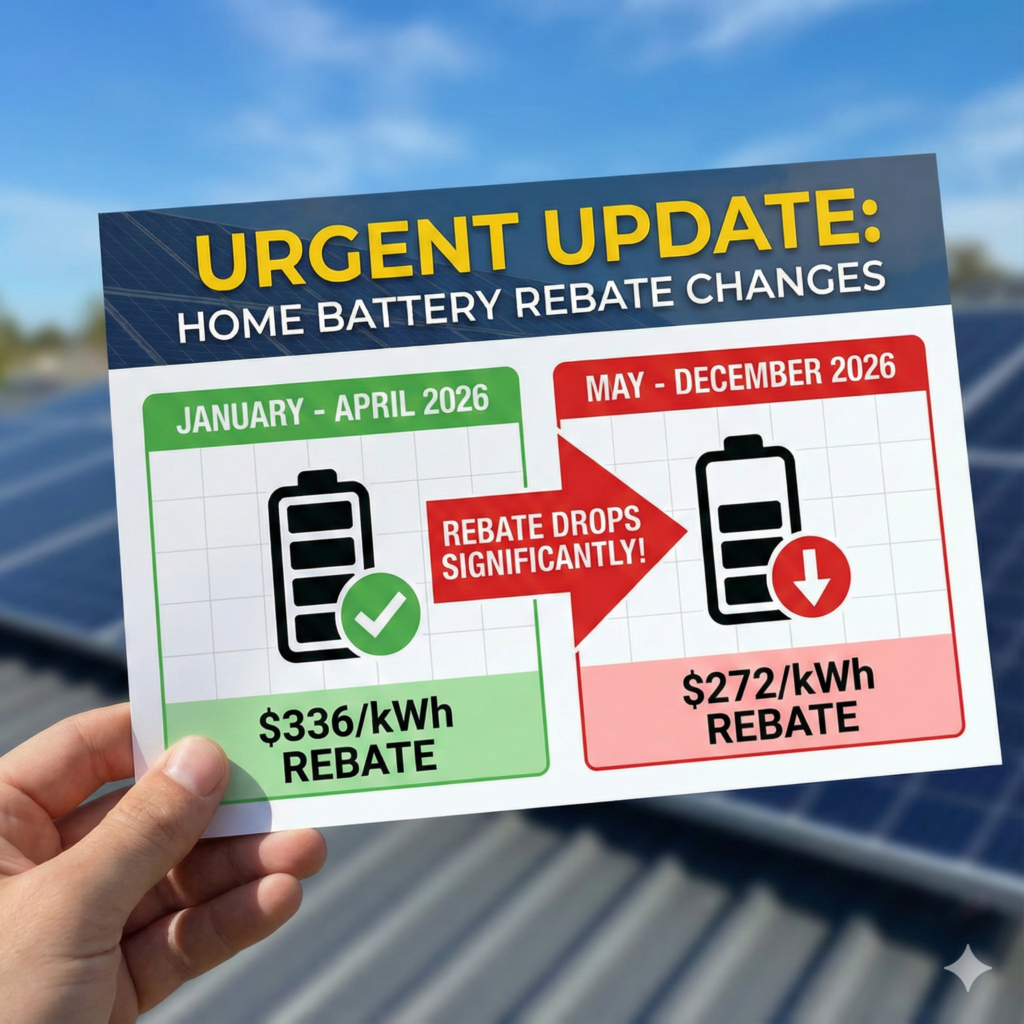
- Jan-April 2026: $336 per kWh
- May-Dec 2026: $272 per kWh
- Jan-Jun 2027: $228 per kWh
- Jul-Dec 2027: $208 per kWh
- Jan-Jun 2028: $184 per kWh
- Jul-Dec 2028: $164 per kWh
- Jan-Jun 2029: $144 per kWh
- Jul-Dec 2029: $124 per kWh
- Jan-Jun 2030: $104 per kWh
- Jul-Dec 2030: $84 per kWh
Reduced Rebate For Larger Batteries
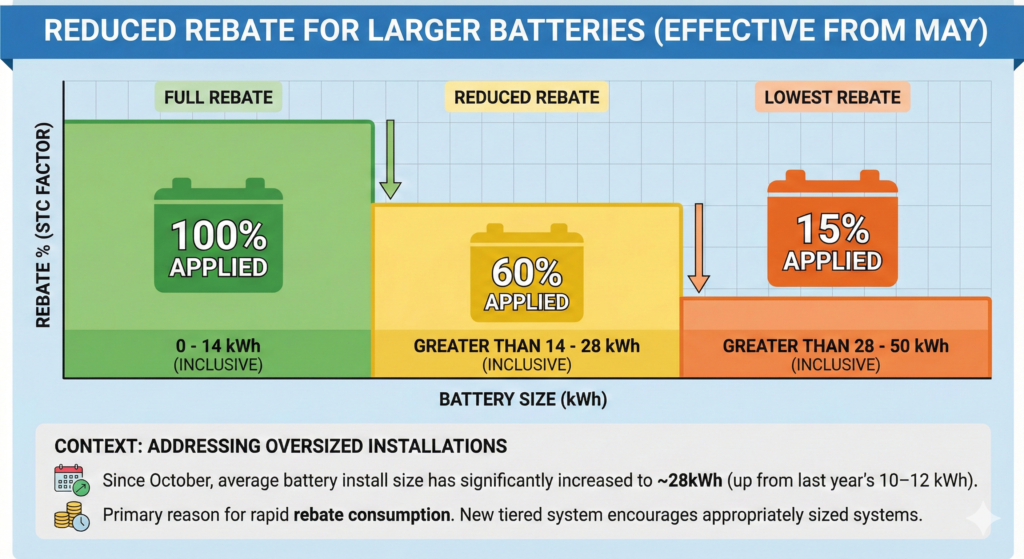
The primary reason the rebate is being consumed so quickly is that households are installing much larger home batteries than expected—often larger than necessary. At a Smart Energy Council briefing earlier this week, it was revealed that battery sizes had averaged about 28kWh since October, a significant increase from last year’s typical install size of 10–12 kWh.
To address this and encourage the installation of appropriately sized batteries, the rebate will only fully apply to smaller systems and will taper down for larger capacity batteries. Subject to regulations, the following changes will come into force from the start of May:
- Up to 14 kWh (inclusive): The STC factor will be applied at 100%.
- For every kWh greater than 14 and up to 28 kWh (inclusive): The STC factor will be applied at 60%.
- For every kWh greater than 28 and up to 50 kWh (inclusive): The STC factor will be applied at 15%.
For example, a 48 kWh VoltX Neovolt Package that currently receives approximately $17,840 off due to the rebate will only receive a $6,880 reduction from May 1.
Batteries up to 100 kWh nominal capacity remain eligible under the Program, but STCs will only be provided for the first 50 kWh of usable capacity. The original structure of the rebate, which paid out "per kilowatt hour" rather than per battery, effectively incentivized installers to sell consumers the biggest possible eligible batteries, often paired with inadequately sized inverters. With a fixed amount of funding available, larger system sizes meant fewer people could benefit from the scheme.
More Rules Add Complexity
The federal government is understood to be unlikely to make further changes in the near future. They are also reluctant to mandate Virtual Power Plant participation due to fears it would stifle uptake of the scheme.
Industry Accepts Need For Changes
The Smart Energy Council noted that with changes not taking effect until May 2026, there is ample forewarning for the industry and consumers. This ensures that installers and homeowners securing batteries in the coming months will not face a reduced rebate for jobs already booked.
“We are a responsible industry that believes in spreading the benefits of solar and batteries to as many people as possible. If that means changes to the rebate we support that,” said Smart Energy Council Chief Executive John Grimes.
This sentiment was echoed by GoodWe Australia Country Manager Dean Williamson. “We do agree that ensuring the ongoing viability of the scheme is essential and support calls to adjust the program. We need time and sensible adjustments, but believe the industry would rather have this than a sudden end,” he said.
A Boon For Australia’s Energy Storage Needs
The scheme has been hugely successful in pushing home batteries into the mainstream and adding significant storage capacity to the grid at a critical moment, as coal plants reach the end of their operational life and large-scale renewable projects roll out slower than needed. These tweaks to the scheme follow the federal government’s decision earlier this week not to extend energy bill subsidies.